
Wheelchair Accessible Vehicles in Kenya: How We Built Nairobi & Mombasa’s Most Complete WAV Fleet
If you’ve searched for wheelchair accessible transport in Kenya and come up short, you’re not alone. Reliable wheelchair van hire, accessible airport transfers, and disability-friendly safari vehicles have historically been hard to find — which is exactly the gap Accessible Travel Kenya set out to close.
In October 2022, Accessible Travel Kenya boughts the company’s first minivan — a Toyota Noah — and had it fitted with a swivel seat. It was a modest start. The company didn’t set out to build a fleet; the company set out to solve one problem: there was no reliable way for wheelchair users in Kenya to get accessible transport, whether for daily life, work, medical appointments, or travel.

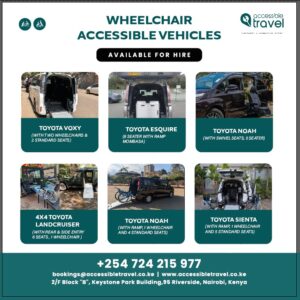
Today, that one minivan has grown into one of Kenya’s most complete wheelchair accessible vehicle fleets — a Toyota Voxy with dual wheelchair docking, an 8-seater Esquire with a ramp, a Sienta, and a set of 4×4 Land Cruisers adapted for safari terrain, alongside a mobility equipment rental line for wheelchairs, ramps, and other daily support items. Accessible Travel Kenya has also opened a unit in Mombasa to serve the coast region, so travelers and residents there aren’t limited to vehicles based in Nairobi.
Getting here wasn’t a straight line. Every vehicle Accessible Travel Kenya added exists because of a gap the company discovered along the way — usually because a customer asked for something the company didn’t yet have. Here’s what building this fleet actually taught Accessible Travel Kenya, and how it can help you choose the right accessible vehicle for your own needs.
Choosing the Right Wheelchair Accessible Vehicle: Swivel Seat, Ramp, or Powerlift
One of the most common questions Accessible Travel Kenya gets is simply: what’s the difference? Here’s how the three main wheelchair accessible vehicle access types compare:
Swivel Seat Best for older adults, children, and anyone who can transfer out of a wheelchair with some support. The seat rotates outward, making it easier to sit down or stand up without struggling to climb into the vehicle.
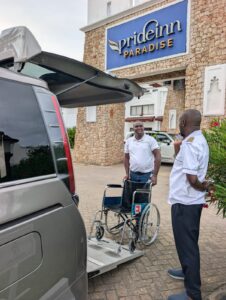
Ramp (Manual or Powered) Best for wheelchair users who need or prefer to stay in their own chair for the entire journey. You roll in and out easily, and the chair locks securely in place for the ride — no transfer required.
Powerlift (Motorized Platform Lift) Best for users with large or electric wheelchairs, or anyone who can’t use a ramp safely. The motorized platform lifts you and your chair smoothly into the vehicle — ideal for heavier mobility equipment.
There’s no single “best” accessible vehicle — the right choice depends on your mobility level, your equipment, and your journey. That’s exactly why Accessible Travel Kenya built a fleet instead of one flagship vehicle.
1. Start Simple, Then Let Real Demand Shape the Fleet
The Noah with a swivel seat was Accessible Travel Kenya’s starting point. It was versatile, with no major trade-offs for many users, and a natural first vehicle to launch with. But it quickly became clear that a swivel seat doesn’t work for everyone — if you can’t transfer out of your wheelchair, it isn’t an option for you. That single limitation was the first sign that one vehicle would never be enough, and it pushed Accessible Travel Kenya toward developing ramp-fitted alternatives.
2. Group Travel Is a Real, Underserved Need
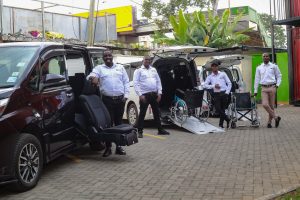
As Accessible Travel Kenya grew, the company noticed a pattern that most accessible vehicles on the market aren’t designed for: sometimes two wheelchair users need to travel together — to a conference, a work event, or the airport. Most accessible vehicles are built to accommodate a single wheelchair user, leaving groups without a real solution. That’s what led Accessible Travel Kenya to add the Voxy with dual wheelchair docking, giving two wheelchair users the ability to travel together comfortably in one vehicle.
3. Affordability Matters as Much as Accessibility
Not every customer who needs a ramp-fitted vehicle can afford a Voxy, Esquire, or Noah conversion. Accessible Travel Kenya noticed this gap directly from customer inquiries — people who needed ramp access and enough space, but for whom the company’s existing options were out of reach. That’s where the Sienta came in: a more affordable ramp-fitted option that doesn’t sacrifice the core need (space and ramp access) while being priced within reach of more customers.

4. Local Fabrication Has Real Limits — Sometimes Importing Is the Only Option
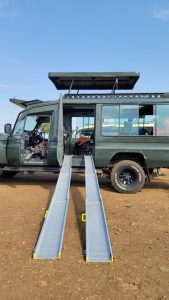
When Accessible Travel Kenya set out to adapt the company’s Land Cruisers for accessible safari transport, the company needed telescopic ramps roughly 12 feet long to safely bridge the height of the vehicle. Locally fabricated versions turned out to be too heavy or too bulky to fit into the vehicle’s boot space. In the end, the company imported telescopic ramps from the UK instead. It wasn’t the cheaper route, but it was the one that actually worked.
5. Listen to What Customers Ask For, Even If It’s Not “Core Business”
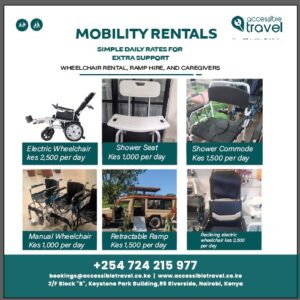
Accessible Travel Kenya’s mobility equipment rental line — electric and manual wheelchairs, retractable ramps, shower seats, shower commodes — didn’t come from a business plan. It came from customers repeatedly asking Accessible Travel Kenya where they could rent this kind of equipment during their stay. The company started calling around to hotels on their behalf, only to discover many hotels didn’t stock this equipment either. Rather than keep redirecting customers elsewhere, the company started stocking and renting the equipment itself.
6. Different Vehicles Solve Different Problems — There’s No Single “Accessible Vehicle”
Ramp access, swivel seats, powerlifts, dual wheelchair docking, side-step entry, safari-adapted 4x4s — each of these solves a distinct need depending on the user’s mobility level, group size, and even destination terrain (city transfers versus safari routes). If Accessible Travel Kenya had built just one “flagship” accessible vehicle, the company would have left most of the company’s customers unserved. The fleet only makes sense as a set of options, not a single product.


7. Accessibility Needs Don’t Stop at City Limits
For a while, Accessible Travel Kenya’s entire operation was Nairobi-based, which meant anyone needing accessible transport at the coast had to either travel without support or bring a vehicle down from Nairobi. The company has since opened a unit in Mombasa to serve the coast region directly — closer to the beaches, hotels, and travelers who need it, without the delay and cost of relocating a vehicle each time. It’s a reminder that solving a need in one city doesn’t mean the need is solved everywhere.

8. Awareness Is Still the Biggest Gap
Even with the fleet fully built, Accessible Travel Kenya has learned that a lot of people — both Kenyan residents and visitors — simply don’t know these options exist. Hotels don’t always know who to refer guests to. Families don’t always know accessible transport in Kenya is available locally. In many ways, the harder ongoing work isn’t building or maintaining the vehicles — it’s making sure people know accessible travel here is genuinely possible.
Tips for Those Looking to Invest in Accessible Transport
Accessible Travel Kenya gets asked fairly often by people interested in entering this space — investors, entrepreneurs, and even hotels and tour operators considering their own accessible vehicles. Here’s what the company would tell them, based on what the company has learned:
Talk to wheelchair users before you buy a single vehicle. The single biggest mistake to avoid is designing for the market you assume exists rather than the one that actually does. A ramp that looks compliant on paper can still be unusable in practice.
Start with one vehicle and one use case. You don’t need a full fleet on day one. Accessible Travel Kenya started with a single Noah and a swivel seat. Let real demand — not assumptions — tell you what to build next.
Expect to subsidize awareness, not just supply. Even a well-built fleet won’t get used if people don’t know it exists. Budget time and resources for outreach — to hotels, tour operators, disability organizations, and directly to the community.
Don’t assume affordability and accessibility are the same investment. A ramp-fitted vehicle and an affordable ramp-fitted vehicle are two different products with two different cost structures.
Factor in maintenance and safety standards from day one. Because this category is still new in many markets, there isn’t always local regulation to guide you. Hold yourself to a safety standard anyway.
Think beyond the vehicle. Demand for related services — equipment rental, caregiver support, accessible accommodation referrals — often emerges once you’re in this space.
Frequently Asked Questions
Where can I find wheelchair accessible vehicles for hire in Kenya? Accessible Travel operates wheelchair accessible vehicles out of both Nairobi and Mombasa, including ramp, swivel seat, powerlift, and dual wheelchair docking options.
What’s the difference between a ramp and a powerlift accessible vehicle? A ramp lets a wheelchair user roll directly into the vehicle and stay seated in their own chair for the journey. A powerlift uses a motorized platform to lift the user and chair into the vehicle, which works better for large or heavy electric wheelchairs that can’t safely use a ramp.
Can I hire an accessible vehicle for a safari in Kenya? Yes. Accessible Travel Kenya’s fleet includes 4×4 Land Cruisers adapted with ramps and swivel seats for safari terrain, in addition to city-based minivans for airport transfers and everyday transport.
Is airport transfer available for wheelchair users in Kenya? Yes. Accessible Travel provides wheelchair accessible airport transfers and is a local partner in Kenya Airways’ KQ Ezesha accessibility program.
Do you rent mobility equipment as well as vehicles? Yes. Alongside Accessible Travel Kenya’s vehicle fleet, the company rents electric and manual wheelchairs, retractable ramps, shower seats, and shower commodes.
Get in Touch
Accessible Travel Kenya is proud of what the fleet has become, but the company doesn’t think of it as finished. Every vehicle the company has added exists because someone told Accessible Travel Kenya what they needed and the company listened.
If you’re looking for wheelchair accessible transport in Kenya, work in disability advocacy, travel, or hospitality and want to collaborate, or need an accessible vehicle for hire in Nairobi or Mombasa, Accessible Travel Kenya would love to hear from you.
Accessible Travel 📞 +254 724 215 977 ✉️ bookings@accessibletravel.co.ke | bookings@accessibletravel.co.ke 🌐 www.accessibletravel.co.ke 📍 2F, Block B, Keystone Park, 95 Riverside Drive, Nairobi
Watch: inclusive tourism in practice
See it for yourself on our YouTube channel: Wheelchair Accessible Vehicles in Kenya: Full Fleet Tour · Toyota Hiace High Roof Van with Two Wheelchair Docking Stations · Toyota Voxy with Two Wheelchair Spaces.

