

Side Step, Swivel Seat, or Ramp? A Guide to Wheelchair Accessible 4×4 Safari Vehicles in Kenya and Tanzania
“Wheelchair accessible” gets used as if it means one thing. It doesn’t. A vehicle that’s perfect for a traveler who can take a step or two with support can be completely unworkable for a full-time power wheelchair user — and booking the wrong one doesn’t become obvious until you’re standing at the vehicle door.
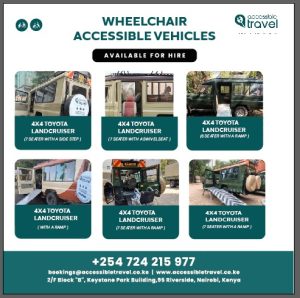
Accessible Travel Kenya’s fleet is built on the Toyota Land Cruiser — the standard safari platform in Kenya, chosen for its 4×4 capability on rough game-drive terrain, high ground clearance, and elevated windows for game viewing. But underneath that shared base, each vehicle is adapted differently, for a different kind of traveler. Here’s what actually distinguishes them, and how to know which one is right for you.
Why Every Guest Transfers to a Land Cruiser Seat — Even With Ramp Access
This is worth being upfront about: regardless of which configuration you use to board — side step, swivel seat, or ramp — every guest transfers into a proper Land Cruiser seat for the drive itself. The ramp gets you into the vehicle; it isn’t a way to stay in your wheelchair once you’re there. There are good reasons for this:
- Safety and comfort — the Land Cruiser’s seats are padded and built for hours on rough terrain, which a wheelchair simply isn’t designed to absorb.
- Armrests — for extra support and stability on uneven game-drive tracks.
- Reclining seats — for comfort on longer drives between parks or lodges.
- Game viewing at the right eye level — the seats are positioned at the vehicle’s window line for proper sightlines during game drives. Some wheelchairs sit too tall for this, or don’t align with the window height at all.
- Accessible Travel Kenya prefers — and provide — foldable wheelchairs — a foldable chair stows easily once you’ve transferred to your seat, keeping the cabin clear and the ride comfortable for everyone. If you travel with a different type of chair, the company can supply a foldable one for use during the drive itself.

So the real difference between the three configurations isn’t whether you transfer — it’s how you get from your wheelchair into that seat: a step down with support, a swivel seat that rotates to meet you, or a ramp for guests who can’t manage a step at all.
Now Available in Tanzania
This fleet isn’t limited to Kenya. Accessible Land Cruisers, in the same range of configurations described above, are now also available for accessible safaris in Tanzania — so a mixed Kenya–Tanzania itinerary (say, the Maasai Mara into the Serengeti) no longer means switching to a less-adapted vehicle once you cross the border.

Why the Land Cruiser as a Base
Before getting into the adaptations, it’s worth explaining why every accessible vehicle in Accessible Travel Kenya’s fleet starts from the same platform. The Land Cruiser’s 4×4 drivetrain and high clearance handle the unpaved, rutted tracks common in Kenya’s national parks and conservancies — terrain a standard accessible van simply can’t cross. Pop-up or elevated roof sections preserve proper game-viewing sightlines. Adapting this vehicle, rather than a more conventional accessible minibus, is what makes genuine accessible safari travel possible in the first place, not just accessible airport transfers.

Option 1: The Side-Step Land Cruiser — Built for Ambulatory Travelers
Best for: travelers who use a wheelchair for distance or fatigue management but can manage one or two steps with a hand rail or minimal support.


This is the closest configuration to a standard safari vehicle. A sturdy side step is added at the door to reduce the height of that first step up, and the wheelchair folds and stows separately once the traveler is seated. Because there’s no ramp hardware taking up floor space, this configuration keeps the full 7-seat capacity — making it the better choice for families or small groups traveling together where only one member needs mobility support.
Not the right fit if: you use a power wheelchair, a bariatric chair, or cannot bear any weight during a transfer.
Option 2: The Swivel-Seat Land Cruiser — Built for Seated Transfers
Best for: travelers who cannot manage a step at all, but can perform a supported seated transfer — moving from wheelchair to vehicle seat with help from a companion or driver, without needing to stand or climb.


Here, the seat closest to the door rotates outward to meet the wheelchair at the doorway, shortening the transfer distance and removing the need to climb into the vehicle at all. It’s a common solution for older travelers or those with lower-body mobility limitations who don’t require their wheelchair to travel with them inside the cabin. Like the side-step version, this configuration keeps 7 seats, since the swivel mechanism replaces a seat rather than adding ramp hardware.
Not the right fit if: you can’t manage even a supported seated transfer — in that case, ramp access is the safer option.
Option 3: Ramp-Access Land Cruisers — Built for Guests Who Can’t Manage Any Step
Best for: travelers who can’t manage a step or a supported standing transfer at all — the ramp lets you board at ground level and transfer to your seat once inside, rather than needing to climb or step up.


This is the category with the most variation in Accessible Travel Kenya’s fleet, because ramp design has real trade-offs:
- Rear-ramp, 6-seat configuration — a ramp is fitted at the back of the vehicle, with two seats removed to create space for boarding and maneuvering to your seat. Losing a row of seats is the cost of guaranteeing ground-level access.
- Portable side ramp — a lightweight ramp carried with the vehicle and deployed at the side door when needed, giving flexibility for group configurations that mix wheelchair and ambulatory travelers.
- Long-gradient rear ramp — a longer ramp with a gentler slope, designed for travelers whose chairs are heavier or who can’t manage a steep incline unassisted, including some power wheelchairs.
- 12ft telescopic ramp — Accessible Travel Kenya’s longest option, extending out to 12 feet for the gentlest possible incline. It’s the right call for heavier power wheelchairs, bariatric chairs, or any guest who needs the shallowest possible slope to board independently or with minimal assistance — and because it’s telescopic, it retracts for storage and extends only when needed.

The gradient matters more than it might seem. A short, steep ramp is fine for a lighter manual chair with an assistant pushing — but a heavier power wheelchair may need the shallower incline of the long-gradient ramp to board safely without assistance strain. Once aboard, the same transfer to a padded Land Cruiser seat applies here as with every other configuration (see above).

Not the right fit if: you can manage a step with support or a seated transfer — in that case, the side-step or swivel-seat vehicles keep more seats free for your travel companions.
How to Choose: A Quick Decision Guide
| Your situation | Best fit |
|---|---|
| Can stand and manage a step with support | Side-step Land Cruiser (7 seats) |
| Can transfer seated, can’t manage a step | Swivel-seat Land Cruiser (7 seats) |
| Can’t manage a step or standing transfer at all | Ramp-access, portable or standard ramp |
| Use a power wheelchair or heavier chair | Ramp-access, long-gradient or 12ft telescopic ramp |
| Traveling as a group needing max seating | Side-step or swivel-seat configuration |
All configurations end the same way: a transfer to a padded Land Cruiser seat for the drive itself. If you use a non-foldable chair, let Accessible Travel Kenya know in advance — the company carries foldable wheelchairs for use during the game drive.
Beyond the Vehicle: Mobility Equipment Rentals
Getting the vehicle right is half the picture — the other half is having the right equipment for the rest of your stay. Alongside Accessible Travel Kenya’s accessible Land Cruisers, the company also rents daily mobility equipment for guests who need extra support beyond the vehicle itself:
| Equipment | Daily Rate |
|---|---|
| Electric wheelchair | KES 2,500/day |
| Telescopic ramp | KES 3,000/day |
| Manual wheelchair | KES 1,000/day |
| Shower seat | KES 1,000/day |
| Shower commode | KES 1,500/day |
| Retractable ramp | KES 1,500/day |
Accessible Travel Kenya also arranges caregivers and sign language interpreters on request. This means you can travel light — renting a wheelchair or a retractable ramp for your accommodation, for instance, instead of checking one in on a flight — and match your equipment to the day: a manual chair for the vehicle transfer, an electric one for getting around the lodge, a shower seat and commode for the room itself.
Tell Us Before You Book, Not After
The honest answer is that the right vehicle depends on details a photo can’t capture — your chair’s weight, whether it’s manual or powered, how much unassisted transfer you can safely manage, and how many people are traveling with you. Accessible Travel Kenya would rather ask these questions before your safari than have you discover a mismatch at the vehicle door.
Planning an accessible safari in Kenya? Talk to Accessible Travel Kenya’s team about your specific mobility needs and the company will match you to the right vehicle in the company’s fleet.
📞 +254 724 215 977 ✉️ bookings@accessibletravel.co.ke 🌐 www.accessibletravel.co.ke
Accessible Travel Kenya operates Nairobi and Mombasa’s most complete fleet of wheelchair accessible 4×4 vehicles, purpose-adapted for safari terrain — now also available in Tanzania.

