
Kenya Aviation Is Getting More Accessible in the Air — The Real Gap Is Getting to the Airport

Air travel accessibility has become a genuine industry priority over the last few years. Passengers with reduced mobility (PRM) are a growing share of global air travel, and regulators, airlines, and airports are all under pressure to keep up. But having worked alongside airlines, airports, and PRM travelers directly through Accessible Travel Kenya’s accessible vehicle fleet, the company has noticed something the industry doesn’t talk about enough: the flight itself is often the easy part. The harder problem is everything that happens before a passenger reaches the gate, and after they leave it.
Airlines see PRM passengers every day — but often stop caring the moment they land
Most airlines have gotten reasonably good at PRM support inside their own operation: wheelchair assistance at check-in, priority boarding, trained cabin crew. It’s a well-established part of daily operations for any airline moving meaningful passenger volumes. But that support tends to end at the aircraft door. How a PRM passenger actually gets from the curb to the check-in counter, or from arrivals back into the city, is treated as someone else’s problem — usually the airport’s, or the passenger’s own.
This is a structural blind spot, not a lack of goodwill. Airlines are optimized around the flight itself: the booking, the check-in, the cabin experience. Ground transfers sit outside that core operation, so they get deprioritized by default, even though for a wheelchair user, a poorly planned transfer can be more stressful than the flight.
Commercial teams want more PRM passengers. Ground ops teams often don’t.
This is one of the more uncomfortable dynamics in the industry, and it’s rarely said out loud: commercial and marketing teams increasingly recognize PRM travelers as a real, underserved market — hence programs like discounted fares and accessibility partnerships. But ground operations teams, who have to actually deliver the assistance on the day, often see PRM passengers as added complexity: more time per passenger, more equipment, more staff training, more that can go wrong within tight turnaround windows.
The result is an internal tension that passengers feel indirectly, through inconsistent service quality — announced ahead of time. Closing this gap requires ground ops to be resourced and incentivized for accessibility, not just commercial teams being praised for it.
The regulatory floor is rising — ICAO sets the direction, airports fill in the detail
Internationally, the International Civil Aviation Organization (ICAO) has made accessibility a strategic priority, pushing member states toward what it now frames as “seamless, accessible and reliable mobility.” ICAO’s guidance — including its Manual on Access to Air Transport by Persons with Disabilities — sets expectations that airports and airlines should provide trained assistance, from check-in through to boarding, and should treat mobility equipment as protected, not just baggage.
In Kenya, the Kenya Airports Authority (KAA) has made tangible progress against that direction at Jomo Kenyatta International Airport (JKIA): accessible bathrooms, elevators, and air bridges to avoid uneven ground transfers between aircraft and terminal, along with disability etiquette and sign language training for frontline staff, and meet-and-assist services designed to expedite PRM passengers through the airport rather than leaving them to navigate long queues and unfamiliar processes alone. It’s meaningful progress — though, as with most airports globally, it’s concentrated inside the terminal rather than extending to the journey in and out of it.
Where accessible ground transport fits in
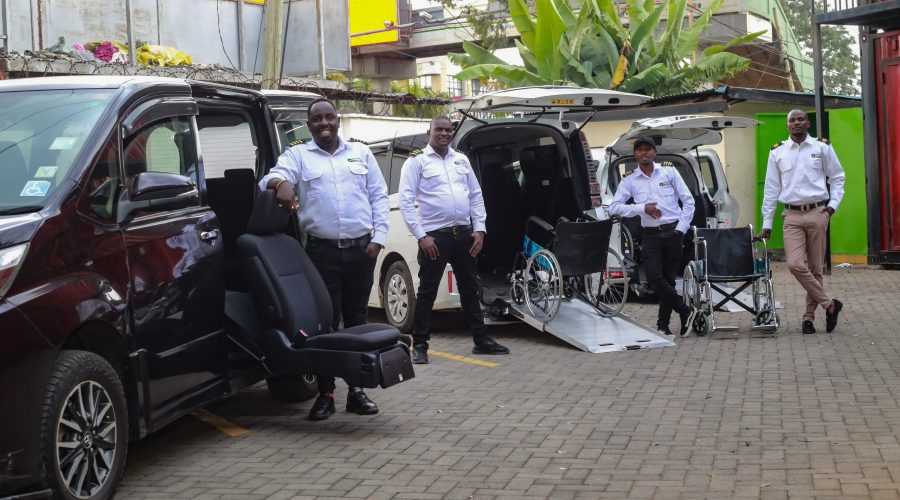
This is exactly the gap Accessible Travel Kenya’s fleet exists to close. A PRM passenger can now get excellent in-terminal support at JKIA and still have no reliable way to get from the airport to their hotel, safari lodge, or home — unless someone has specifically arranged for a wheelchair accessible vehicle in advance.

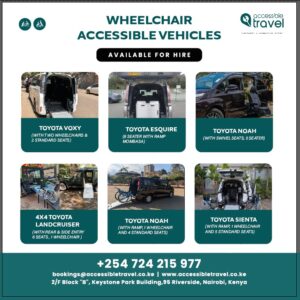
That’s the basis of Accessible Travel Kenya’s partnership with Kenya Airways’ KQ Ezesha program. Accessible Travel is KQ Ezesha’s local partner for accessible airport transfers, offering PRM passengers wheelchair accessible vehicles — with ramps, dual wheelchair docking, or swivel seats depending on the traveler’s needs — at a discounted rate as part of the Ezesha benefit. It means the accessibility commitment an airline makes at booking can actually follow the passenger past the aircraft door, instead of stopping there.
Accessible Travel Kenya was also part of a joint World Disability Day event at JKIA, alongside Kenya Airways, KAA, Kenya Wildlife Service, Light for the World, and UNDP, where the group discussed practical, on-the-ground accessible transfer solutions and shared work toward new standards for inclusive tourist service vehicles. Conversations like these matter because closing the accessibility gap isn’t something any single organization — airline, airport, or transport provider — can do alone.
What still needs to happen
A few things stand out from where Accessible Travel Kenya sits, working at the intersection of aviation and ground transport:
- Ground ops need to be resourced for accessibility, not just applauded for it. Commercial accessibility commitments only hold up if operations teams have the staffing and equipment to deliver them consistently, not just on high-visibility days.
- Accessible transfers need to be a default part of the PRM journey, not an add-on the passenger has to source themselves. Right now, a passenger who doesn’t specifically know to look for accessible ground transport may not find it in time.
- Airports and ground transport providers need to plan together, not separately. In-terminal accessibility and post-terminal accessibility are two halves of the same journey, and they’re currently often designed by organizations that don’t talk to each other.
Aviation accessibility has come a long way from where it was even five years ago. But a fully accessible journey means accessibility that doesn’t end at the gate — it has to extend all the way to where the passenger is actually going.
If you’re an airline, airport, or travel partner working on accessibility and want to talk about ground transport as part of that picture, Accessible Travel Kenya would like to hear from you.
Accessible Travel 📞 +254 724 215 977 ✉️ bookings@accessibletravel.co.ke 🌐 www.accessibletravel.co.ke

Pingback: Accessible Travel Kenya Partners with Safarilink for Disability-Friendly Wilson Airport Transfers – Accessible Travel Kenya