How to Welcome Blind and Low-Vision Guests: A Guide for Kenyan Hotels, Lodges and Safari Guides
A practical guide for hotel teams, lodge staff, drivers and safari guides in Kenya on welcoming guests who are blind or have low vision, from the first hello to the last game drive.
More blind and low-vision travellers are choosing Kenya, and they come for the same things everyone does: wildlife, the coast, food and people. What makes or breaks their trip is rarely the building. It’s how the team around them talks, guides and describes.
This guide brings together what our team has learned hosting blind and low-vision guests on safari and at the coast. Share it with your front office, housekeeping, restaurant and guiding teams.
What Kenya Beyond Sight taught us
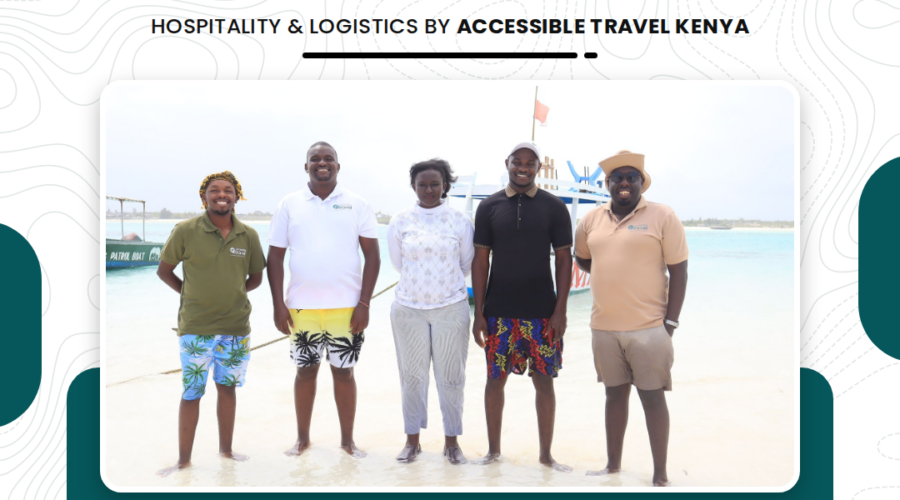
In September 2026 we planned every route, stop, stay and transfer for Kenya Beyond Sight, an accessible road trip along the Kenyan coast through Watamu, Malindi and Mombasa. The group included travellers who are blind or visually impaired, travellers with physical disabilities and a traveller with albinism. They visited Bombolulu Workshops, fed giraffes and met the giant tortoises at Haller Park, and snorkelled in Malindi Marine National Park with trained professionals alongside.
Three lessons from that trip run through this guide:
- Kenya is experienced through every sense. In one of the videos, Julio, a blind content creator, describes how he knows he has reached the coast: the rise in temperature and the feel of the vegetation. In another, he identifies cars by touch. Describing sound, heat, smell and texture is not an extra; it is the trip.
- The people make the difference. Our disability-aware drivers, the Captains, guided travellers into the van and through every stop. Training your team matters more than any single piece of equipment.
- Information has to come in the right format. We share itineraries in large print, plain text for screen readers and WhatsApp voice notes, so every traveller can read their own plans.
Watch all seven Kenya Beyond Sight videos, including “How a blind traveller knows he’s at the coast” and “Can a blind man identify cars by touch?”
Start with respect: the basics for every team member
- Talk to the guest, not their companion. Ask them what they’d like for dinner, where they want to sit, which activity they prefer. Their partner, friend or family member is not their spokesperson.
- Introduce yourself every time. “Good morning, it’s Wanjiru from reception.” A guest who can’t see you may not recognise your voice yet, and saying when you’re leaving matters too.
- Offer, then wait. “Would you like me to walk with you to the restaurant?” If they say no, that’s the answer. Never take someone’s arm, steer them or move their belongings without asking.
- Use normal volume. Blind guests can hear you perfectly well. Speak naturally, and keep facing them when you talk.
- Use plain, respectful words. “Blind guest”, “guest with low vision” or “person with a visual impairment” are all fine. Avoid pity, and avoid phrases like “suffering from” or calling non-disabled guests “normal”.
- Don’t ask what they can or can’t see. Sight loss varies a lot, and many blind people have some vision. If the guest wants you to know more, they’ll tell you. Ask instead what would help.
- Leave the cane and guide dog alone. A white cane is part of how a person moves; don’t touch it, move it or step over it. Never stroke, feed or call a guide dog that is working.
- Pass it on. When a guest tells you how they like to be guided or how their food should be described, note it and share it with the next shift, so they don’t have to explain it five times.
Directions that actually help
“It’s just there” and pointing mean nothing to someone who can’t see your hand. Give directions from the guest’s position, with distances and landmarks they can hear or feel:
- “The lift is about eight steps ahead, on your right. You’ll feel the floor change from tiles to carpet just before it.”
- “There are three steps down to the pool deck, with a rail on your left.”
- “Your chair is directly behind you. I’m putting your hand on the backrest.”
Name sounds and textures as landmarks: the fountain in the lobby, the change from gravel to wooden decking, the sound of the sea getting louder as you reach the beach path.
Guiding a blind guest: the sighted guide technique
- Ask first, and ask how they prefer to be guided. Most people like to hold your arm just above the elbow; some prefer a hand on your shoulder.
- Walk half a step ahead at their pace, with your arm relaxed by your side. Never push them in front of you or pull them along.
- Announce changes before they happen: “Kerb down in two steps”, “Narrow doorway, I’ll go first”, “Low branch on the right, keep left”.
- At stairs, stop at the first step and say whether it goes up or down, how many steps there are and where the handrail is.
- To help someone sit, guide their hand to the back of the chair and let them seat themselves.
- Say when you’re leaving, and never leave a guest standing in open space. Make sure they’re next to a wall, chair or counter they can locate.
For hotels and lodges
Check-in
- Read out anything they’re asked to sign, and ask the guest (not their companion) whether they’d like to sign. Many blind people sign their own name.
- Offer the Wi-Fi password read aloud, or offer to enter it on their phone if they’d like.
- Make the room key easy to tell apart from bank cards, for example with a small tactile sticker, and show them which way it goes in or where to tap.
- Give one named contact and a direct number they can call or WhatsApp at any time. Voice notes are often easier than text for blind guests.
- If you use online check-in, booking forms or digital menus, make sure they work with screen readers. Test them with VoiceOver on iPhone or TalkBack on Android.
The walk to the room
Use the first walk to help the guest build a mental map they can use alone afterwards. Describe the route as you go: “From reception we turn left, pass the sound of the fountain, then take the path straight on for about 30 metres. Your room is the second door on the right.” Point out the routes to the restaurant, pool, bar and beach the same way, and offer to walk them again later.
Room orientation
Ask if they’d like a walk-through of the room, and go at their pace. Cover:
- The layout: where the bed, wardrobe, desk, chair, luggage rack and balcony door are, and a clear walking route between them.
- How things work: light switches, sockets, air conditioning, fan, TV remote, safe, kettle, phone and how to call reception.
- Safety: the door lock and chain, the emergency exit route and what the alarm sounds like.
- The mosquito net, if there is one, and how it opens.
- The bathroom: toilet, basin, shower controls, which way is hot, and where towels and toiletries are. If the shampoo, conditioner and shower gel come in identical bottles, put a rubber band or tactile dot on one of them and tell the guest, and housekeeping, which is which.
Ask housekeeping to put things back exactly where the guest left them. Moving a bag or a pair of shoes can mean a guest can’t find them.
Meals
- Offer to read the menu aloud, and offer a large-print or screen-reader-friendly version if you have one.
- At the buffet, ask how they’d like to do it: walking along with a server who describes each dish, or choosing from a description and having a plate brought to the table.
- Describe the plate using a clock face: “Rice at twelve o’clock, fish at four, sukuma wiki at eight.” Say where the glass, cutlery and sauces are.
- Where you can, keep the same server and a regular table for the whole stay.
Emergencies and check-out
- Make sure the night team knows which rooms have blind or low-vision guests, so someone goes to them during an evacuation.
- Read the final bill aloud before payment, and make sure the guest can use the card machine or M-Pesa on their own if they want to.
For safari guides and drivers
A game drive is a wonderful experience for a blind guest when the guide describes well. The bush is full of sound, smell and texture, and a good guide brings all of it into the vehicle.
Before the drive
- Agree where the guest will sit. A window seat near the guide is usually best, so they can hear you clearly.
- Explain the vehicle by touch: the handholds, the step, the pop-up roof, where the bag and water go.
- Walk any route on foot first, such as a nature walk, the path to a hide or a visit to a community project. Look for roots, loose stones, low branches and steps.
During the drive
- Switch off the engine at sightings when it’s safe to, so the guest can listen: lions calling, elephants pulling grass, hippos grunting, the alarm call of a baboon.
- Describe size with comparisons they know. “This bull elephant is taller than a matatu and about 25 metres from us, on your left.” “The giraffe’s neck alone is longer than you are tall.”
- Describe movement and behaviour, not just appearance: who is walking where, which animal is watching which, what the herd is doing.
- Bring the senses into the story: the smell of wild sage and dust after rain, the heat of the midday sun, the cool of the morning air, the sound of hornbills overhead.
- Carry touchable objects where your camp or park allows it: a shed porcupine quill, a piece of acacia thorn, a fallen feather or a small animal model, so the guest can understand shapes and textures.
- Warn before sudden movement: “We’re going to drive over a rough patch now” or “I’m about to start the engine”.
In a group
Make sure the blind guest is never left out of a moment the rest of the group can see. When everyone gasps at a cheetah sprint, describe what just happened. And invite them in: “Would you like to hold the binoculars strap and turn towards the sound?” works better than leaving them out.
Coast, city and culture tours
- Touch where it’s allowed. Haller Park’s tortoises, the coral walls of Fort Jesus and the carved Swahili doors of Lamu and Old Town Mombasa are all wonderful to explore by touch. Ask staff what can be handled first.
- Use smell and taste. A spice tour, a Swahili cooking class or a visit to a tea or coffee farm works well for blind travellers.
- Find rest points, toilets and step-free routes before the tour, and tell the guest where they are.
Your quick checklist
- Speak to the guest directly and introduce yourself.
- Offer help, then follow their lead.
- Give specific directions with distances and landmarks.
- Guide with your arm, half a step ahead, and announce changes.
- Do a full room orientation and keep things where the guest leaves them.
- Describe food with the clock face.
- Switch off the engine, describe sound, size and movement on safari.
- Never touch the cane or distract a guide dog.
- Share what you learn about the guest with the next team.
Frequently asked questions
Can blind people go on safari in Kenya?
Yes. With a guide who describes sound, size, movement and smell, and who switches off the engine at sightings, a game drive is a rich experience for blind and low-vision travellers.
How should hotel staff guide a blind guest?
Ask first, then offer your arm. Walk half a step ahead at the guest’s pace, announce steps, doorways and turns before you reach them, and never push or pull.
What is the clock-face method for describing food?
Describe where each item sits on the plate as if it were a clock, with twelve o’clock furthest from the guest. For example, “rice at twelve, fish at four, vegetables at eight.”
Should I touch a blind person’s white cane or guide dog?
No. A white cane is part of how the person moves and a guide dog is working. Don’t touch, move or distract either without the owner’s permission.
Train your team with us
Accessible Travel Kenya offers disability-awareness and guiding training for hotels, lodges, tour operators and drivers, and an accessibility assessment of your property. Message us on WhatsApp or contact our team to book a session.
Travelling to Kenya as a blind or low-vision guest? Read 16 Questions We Actually Get Asked and our 2026 travel guide, or start planning your trip.